Eight months into Asha Sharma’s run as the boss of Xbox, the honest answer to “how’s Xbox doing?” is: better in some places, worse in others, and still very much mid-surgery. Game Pass is cheaper than it was a year ago, real console exclusives are back, and Microsoft finally has a written plan with dates on it. It also cut thousands of jobs, let go of beloved studios, and raised console prices again, and its hardware is still selling poorly.
Here’s where things stand on November 1, 2026, and what Sharma says she’s building.
Some quick background first. Microsoft named Sharma CEO of Microsoft Gaming on February 20, when Phil Spencer retired after 38 years at the company and 12 running gaming. Xbox president Sarah Bond left at the same time, and studios chief Matt Booty became chief content officer under Sharma. She isn’t a gaming lifer. Before Xbox she was president of product in Microsoft’s CoreAI group, and before that she was COO at Instacart and a product VP at Meta. In April, Microsoft renamed the whole division XBOX, all caps, with Sharma as CEO.
From her first memo, the message was “the return of Xbox,” starting with console. That was a deliberate turn away from the “every screen is an Xbox” era.
Sharma’s plan, in her own words and numbers
Her first big consumer move came on April 21, when Xbox cut Game Pass Ultimate from $29.99 to $22.99 a month and PC Game Pass from $16.49 to $13.99. The catch was that new Call of Duty games no longer land in Game Pass on day one. They now arrive around the following holiday, roughly a year later. Sharma’s own explanation, quoted by Ars Technica, was blunt: “Game Pass Ultimate has become too expensive for too many players.” Xbox strategy chief Matthew Ball later admitted the 2025 price hike cost “millions” of subscribers over a few months.
In June, Sharma and Booty published a memo on Xbox Wire, “Next 100 Days: XBOX Reset,” that was unusually candid for a corporate post. It said Xbox would close the fiscal year at about a 3% “accountability margin.” It said that outside Activision Blizzard King, Xbox had spent more than $20 billion over five years on content, platform and hardware subsidies while annual revenue actually slipped by nearly half a billion dollars. And it said console storage costs had more than doubled since the fall and then doubled again, with more increases expected. “This cannot continue” is a direct quote.
Then came the cuts. On July 6, Sharma announced the “most significant restructure in XBOX history”: roughly 3,200 roles cut over the fiscal year, about 1,600 of them right away, and four studios leaving Xbox. Double Fine and Compulsion Games went back to independence with their IP. Undead Labs moved to new ownership, and State of Decay 3 will still launch day one on Game Pass. Ninja Theory’s story is sadder. In September, Xbox said two separate deals to sell the Hellblade studio fell through and it was starting consultation on a proposed closure. Arkane’s future is still under review in France. The same September update cut another 268 roles, moved the next Halo game to a new team under Activision, folded Obsidian into Bethesda, and merged Playground and Turn 10 into one Forza and Fable studio.
The long-term targets arrived in a July 30 memo obtained by The Verge and reported by CNBC. By the end of fiscal 2027, which runs through June, Sharma wants Xbox back to growth in both players and revenue, with profits back in line with industry averages. Fiscal 2028 and 2029 are supposed to be the acceleration years. By fiscal 2030, she wants industry-leading margins and to be halfway to a long-term goal of entertaining a billion people every day. The memo groups the work under four C’s: Core (the platform, led by console), Content (turning big games into global franchises), Creation (making Minecraft “the world’s creator platform”), and Connection (film, TV and other ways to extend those worlds). For a sense of the gap, the same memo put Xbox at more than 100 million daily players today.
Exclusives are part of that platform push. At the June showcase, Xbox made Gears of War: E-Day and Clockwork Revolution console exclusives and told VGC they “are not timed exclusives.” Games already announced for PlayStation, like Halo: Campaign Evolved and Forza Horizon 6, are still going multiplatform, and “console exclusive” still means these games come to PC.
The scoreboard so far
Microsoft’s latest earnings, for the quarter ending September 30, give the first real read on the reset. Xbox revenue was $5.38 billion, down 2% from $5.51 billion a year earlier. Content and services also fell 2%, with declines in third-party sales and Game Pass partly offset by Microsoft’s own games. According to the quarterly filing, hardware revenue dropped 14% on lower console volume. Sharma noted on X that the 2% decline beats the 10% drop a quarter earlier. She also said Minecraft and WoW Forever set records and Xbox’s PC platform revenue grew by double digits.
The part getting pushback is hardware. Sharma said console sales “remain constrained by supply, with more demand than consoles available.” But as GameSpot pointed out, the Series X and S are easy to buy at major U.S. retailers, and Circana’s Mat Piscatella said the data he’s seen doesn’t suggest stock is the main problem. It doesn’t help that Xbox raised console prices again on August 1, by $100 for 512GB models and $150 for 1TB models, and dropped the 2TB model. Memory and storage costs are a real problem across the industry. But a $150 increase on a console late in its life is a hard sell, whatever the reason.
Gears of War: E-Day shows the tension inside the business model. The Coalition’s prequel launched October 6 to strong reviews, with an 88 on Metacritic. Then Alinea Analytics estimated it sold about 230,000 copies early on while drawing around 1.7 million Game Pass players, according to Polygon. Microsoft hasn’t confirmed those figures, but they raise the question every Xbox exec has to answer eventually: can day-one Game Pass and full-price blockbuster sales really live together?
The leadership side has been bumpy too. Helen Chiang, the Minecraft veteran Sharma promoted to Xbox’s first-ever COO in July, left Microsoft on October 23, and Microsoft declined to say why. The Verge, citing a Fortune report, also says more layoffs may be planned this fall and in January. Microsoft hasn’t confirmed that.
Then there’s the next generation. At GDC in March, Xbox confirmed Project Helix. It’s a next-gen console on a custom AMD SoC, built to play both Xbox console and PC games, with alpha hardware going to developers in 2027. The same talk announced Xbox mode for Windows 11, which grew out of the ROG Xbox Ally handhelds, and said the Play Anywhere library had passed 1,500 games. Fortune has since reported, via The Verge, that a new Xbox handheld is planned for holiday 2027 and Helix for holiday 2028. The report also says Helix could cost $1,200 to $1,800 unless Microsoft subsidizes it. That’s a rumor, not a price. But with the memory crisis Sharma herself described, it’s not a crazy number either.
Cody’s take
I grew up on a PS2, so I don’t have Xbox nostalgia blinding me. Even so, I think Sharma has done a few genuinely smart things. Cutting the Game Pass price, admitting the old one was too high, and publishing hard numbers about margins and spending are all more honest than the “everything is great” messaging fans got for years. As someone who games mostly on PC, I like that Xbox mode, Play Anywhere and Helix’s PC compatibility all point toward a less walled-off Xbox.
But the human cost is real, and so is the gap between words and results. Losing Ninja Theory would hurt. Telling people demand is outpacing supply while consoles sit on store shelves costs trust. And a $1,200-plus next-gen box, if those reports hold up, would be a non-starter for most players. Sharma has set herself a clear test: player and revenue growth by June 2027. That’s a good thing, because we’ll know soon enough whether this reset is working or whether Xbox is just getting smaller.
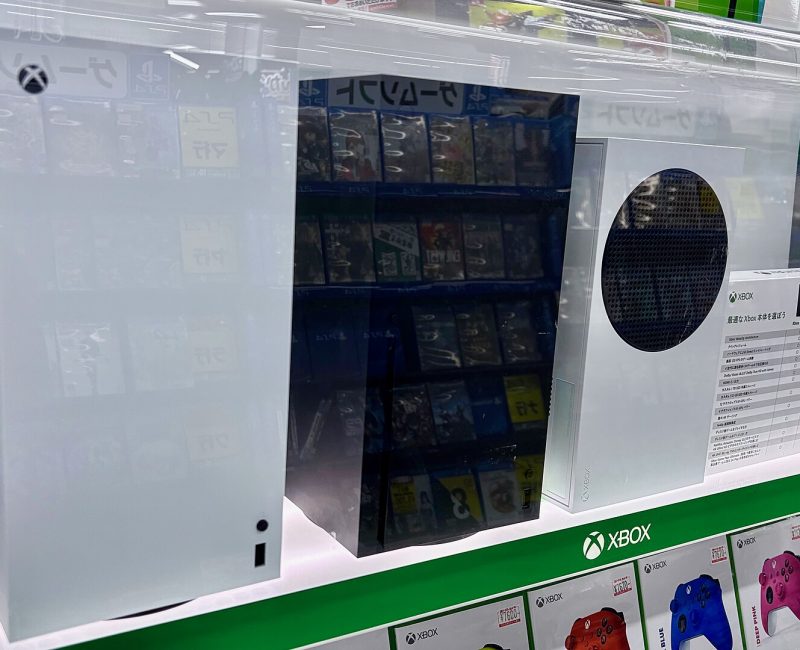
Featured image: Xbox Series X and Series S on a store shelf. Photo: Kyu3a / Wikimedia Commons, CC BY-SA 4.0.
Author