While most of the open-AI conversation this week has been about models so big they need a server room, Kakao went the other direction. On November 6, the Korean tech company put Kanana-2-v-decide on Hugging Face: a 3.67-billion-parameter multimodal model that does not write essays, code or chat replies at all. It answers structured questions with probabilities, choices and scores, and it is small enough that a lot of local AI setups can actually load it.
That is a different bet from the usual “bigger weights, longer context” race. Kakao is aiming at the boring, high-volume decisions that sit inside AI agents: classify this ticket, pick a tool, rate how angry the customer sounds, decide whether a product photo shows damage. If those calls stay slow or fuzzy, the whole agent stalls. Kanana-2-v-decide is built to make them fast and typed.
Here is what shipped, what the numbers actually say, and where the license gets picky.
A model that refuses to write you a paragraph
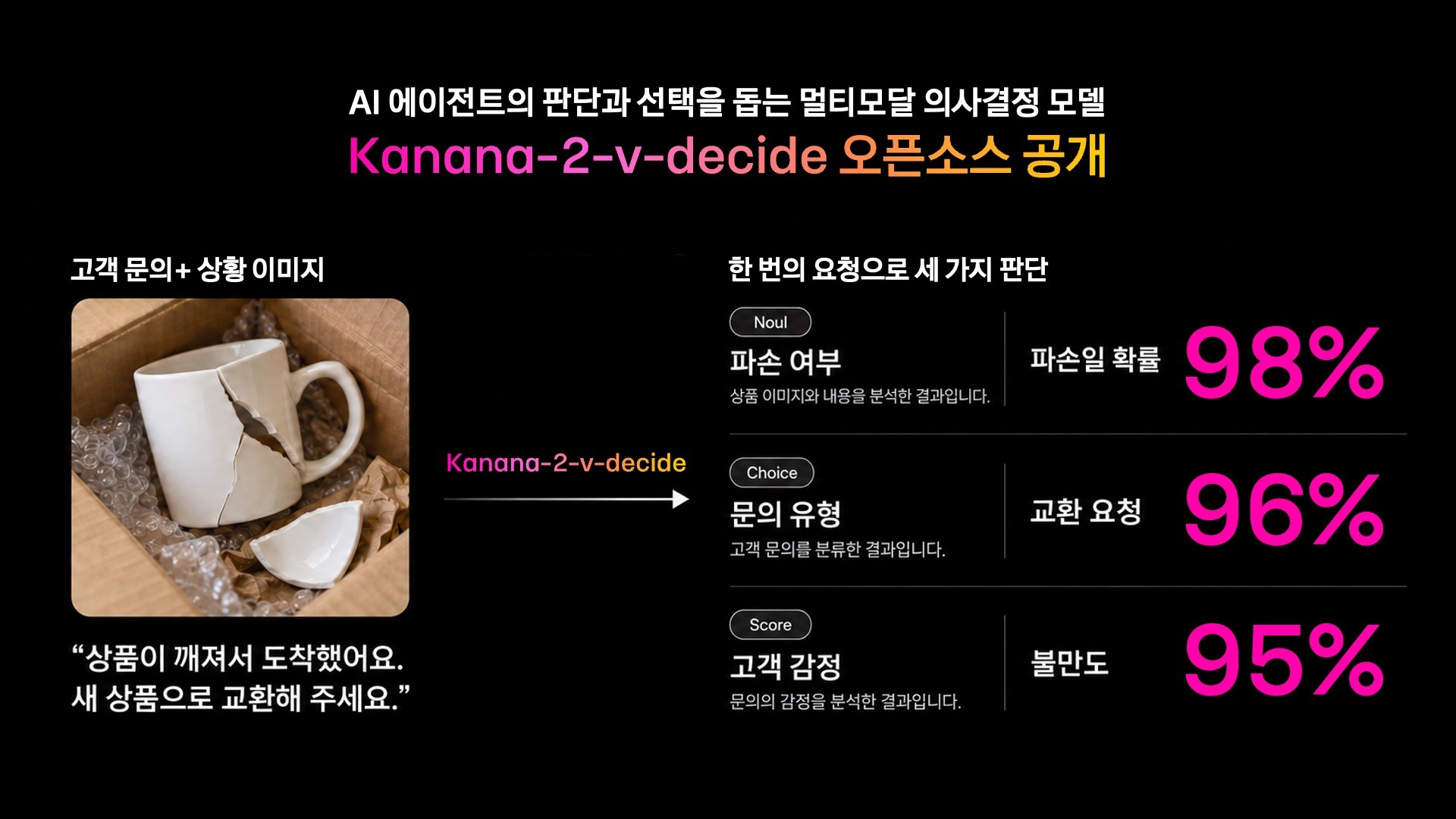
According to the Hugging Face model card and Kakao’s own tech blog, Kanana-2-v-decide-3b-2611 sits on top of Kakao’s Kanana-2-v-3b multimodal stack: a 0.49B vision encoder plus a 3.18B language model, for 3.67B parameters total. The input “state” can be plain text, JSON, or a chat history, with up to 10 images and up to 20,480 tokens. What you get back is not free-form text. You get one of three answer types:
- Choice — pick one option from a map you supply, with a probability for each
- Noul — a yes/no-style probability that a statement is true
- Score — an ordered rating across 2 to 10 levels you define
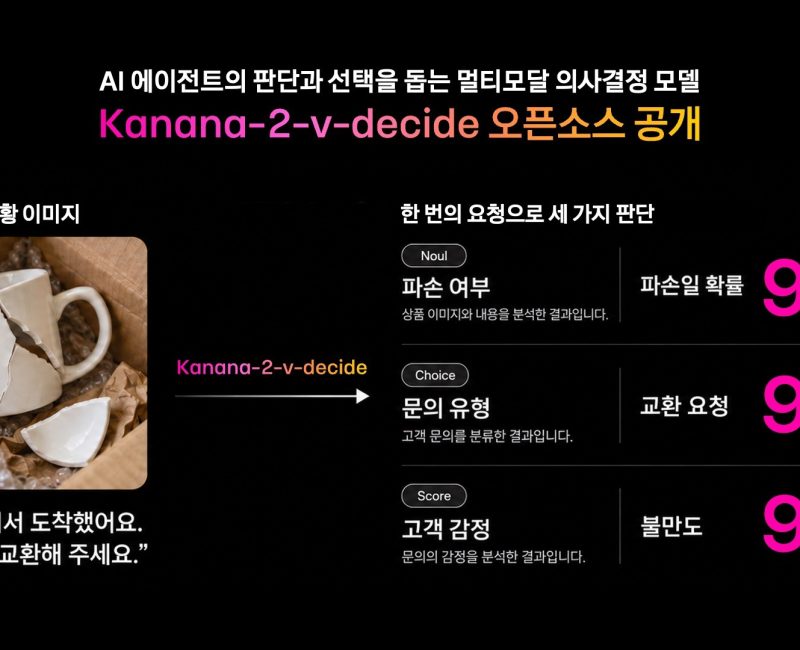
You can ask several of those questions in one request. Kakao’s demo is the damaged-mug case: a photo of a broken ceramic mug in a shipping box plus the message “The product arrived broken. Please exchange it for a new one.” The model returns something like a high probability the item is damaged, “exchange” as the inquiry type, and a dissatisfaction score, all in one pass. That is the point. An agent can wire those fields straight into routing logic instead of parsing a paragraph and hoping the model said “refund” instead of “exchange.”
Under the hood it is an embedding similarity model, not a generative decoder for this task. The card says each question-plus-state is encoded into one embedding, each candidate answer into another, and a softmax over cosine similarities produces the distribution. Candidate embeddings can be cached across calls. That design is why Kakao can talk about sub-100-millisecond decisions on a single high-end GPU, and why changing the option list changes the distribution: the probabilities are relative to the candidates you gave it, not absolute truths about the universe.
On Kakao’s numbers, that speed claim is aggressive. The company says the model averages under 0.04 seconds per judgment on one NVIDIA H200, which it frames as about 43 times faster than GPT-6 Luna for the same kind of call. Treat that as a vendor lab figure on top-shelf hardware, not as what you will see on a gaming PC. Still, the architecture makes the direction believable: no long token stream to sample, just embeddings and a softmax.
The scores look strong, and the caveats matter
Kakao is not shy about the leaderboard. On its Korean in-house set, Kanana Decision Bench (15,909 text questions), the model card lists 72.50. On the public Decision Index 0.4.1 and Decision Index Vision 0.4.1, it posts 61.34 and 61.12 for a 61.23 average, which Kakao says tops the models it compared, including the best Decision Index Vision score in that table. The press release also name-checks Microsoft Decision-1, TypeSafe AI’s Jev, Perplexity’s pplx-decider line and Upstage’s Solar Decide as part of the broader field.
Those comparisons are useful, but they are still Kakao’s tables. Decision Bench is internal. Independent reproduction of Decision Index runs is the next step, not a finished story. For Korean-heavy agent work, the gap Kakao claims over the next models in its own bench is large enough to care about. For English-only pipelines, I would want third-party numbers before swapping out whatever classifier you already trust.

For local AI people, the more interesting number is the file size. The public checkpoint’s model.safetensors is about 7.3 GB. That is a completely different world from this week’s multi-terabyte open drops. With transformers, trust_remote_code=True, and bfloat16 on a CUDA GPU, Kakao’s sample loads the model and calls system_one. There is also a small standard-library HTTP server that speaks a System One-compatible API, so existing Jev-style clients can point at a new base URL. Video is not supported. Extreme aspect-ratio images are not supported. Those limits are documented up front, which I appreciate more than a glossy “runs anywhere” claim.
Licensing is the other place to read carefully. The weights use the Kanana Open License, not Apache 2.0. Research and running the model inside your own product are in scope. Redistribution needs Kakao’s notice file, the license copy, and a clear “Powered by Kanana” credit. Separate commercial permission is required if you want to resell access as an API or cloud service, ship it as an SI or on-prem package, or embed it for on-device products you sell to others. In other words: great for many internal agent stacks, not a free pass to stand up a competing decision API.
Cody’s take
I like this release more than another giant chatbot dump, and I like it for practical reasons. Agents fail on the little decisions constantly: wrong tool, wrong ticket bucket, wrong confidence that a photo shows a cracked screen. A 3.67B model that only does those calls, returns calibrated options, and fits in a single digit of gigabytes is the kind of open weight local builders can actually put next to a RAG pipeline this weekend.
I am not taking Kakao’s “beats everyone” bench story as settled. Vendor benchmarks always need outside checks, and the H200 latency comparison is a lab flex. The license also means you should talk to legal before you productize a hosted decision API. Even with those asterisks, the shape of the release is right. Open AI does not only need bigger models. It needs smaller, boring, reliable ones for the decisions that make agents useful. Kanana-2-v-decide is one of those, and it is live today.
Featured image: official Kanana-2-v-decide launch graphic from Kakao Tech. Image: Kakao.
Author