Most of the open-model news this month has been about giants you need a server rack to run. Tencent just went the other way. On Tuesday, its Hunyuan team open-sourced Hy-MT3, a family of three translation-only models in 1.8B, 7B and 30B-A3B sizes, all under a plain Apache 2.0 license and all with official GGUF files for llama.cpp. The headline number is coverage: Hy-MT3 handles 102 languages, up from 38 in last spring’s Hy-MT2.
The more interesting part for anyone who plays games in more than one language is where Tencent pointed this thing. Hy-MT3 was tuned with help from the Honor of Kings team specifically so it doesn’t wreck game text, the placeholders, color tags and character names that turn a sloppy machine translation into a broken menu. That’s a genuinely useful target. It also comes with a big asterisk: most of the impressive scores are graded by an evaluation system Tencent built itself.
Here’s the lineup. The 1.8B and 7B are dense models, while the 30B-A3B is a mixture-of-experts design that only activates about 3 billion parameters per token. That makes it light on compute, but not on memory, because the whole model still has to be loaded. Tencent publishes BF16, FP8 and GGUF builds for each size on Hugging Face and ModelScope, and the model card covers Transformers (version 5.6.0 or newer), vLLM, SGLang and llama.cpp, plus LoRA and full fine-tuning recipes.
I checked the GGUF repos directly, and the file sizes tell you who each model is for. The 1.8B is 1.35GB at Q4_K_M and 1.91GB at Q8_0, small enough for basically any modern PC or a decent laptop. The 7B is 5.15GB at Q4_K_M, 8.73GB at Q8_0 and 3.87GB in an aggressive IQ2 build. The 30B-A3B weighs 19.5GB at Q4_K_M, 32.79GB at Q8_0 and 13.08GB at IQ2. Those are download sizes, not exact memory requirements, so leave headroom for context. Realistically, the 7B at Q4 is the sweet spot for an 8GB-to-12GB graphics card, while the 30B-A3B at Q4 is 24GB-card or lots-of-system-RAM territory.
One spec worth knowing before you plan a big project: the model cards list a maximum context of 8,192 tokens. That’s plenty for UI strings, subtitles, patch notes or a chat message, but you’ll be chunking anything long like a full script or a novel.
Built so it won’t break your game text
Anyone who has played a rough fan translation or a rushed official localization knows the failure modes. A variable like {player_name} gets translated as if it were a word. A color tag loses its closing bracket. A hero’s name comes out three different ways across three menus. Tencent’s technical report calls this out directly, noting that in games “a single off-target or broken tag can break the game client.”
To measure it, Tencent and the Honor of Kings team built a human evaluation around four error types. In that test, Hy-MT3-30B-A3B had a terminology error rate of 0.08 percent versus 0.54 percent for Gemini 3.1 Pro in thinking mode, a 0.08 percent rich-text error rate versus 0.19 percent, and tied Gemini on placeholder errors at 0.08 percent. Its overall human score was 89.6, ahead of Gemini 3.1 Pro at 88.7, GPT-5.5 at 88.6 and DeepSeek-V4-Pro at 88.3. That’s a tight cluster at the top, but the gap on terminology is real if the numbers hold up.
The model also plugs into TiMiHOKGameTranslator, an open toolchain from the TiMi studio’s Honor of Kings group. It goes beyond translation: there are Unity and Unreal Engine plugins that capture the UI tree, text and localization keys from a running game, then re-render the screen in another language so a QA tool can flag missing translations or text that overflows its box. For indie developers who can’t afford a full localization QA team, that end-to-end pipeline might matter more than the model itself. One small wrinkle: the toolchain’s README still describes the Hunyuan translation series as covering 33 languages, so its docs haven’t fully caught up with the new release.
Tencent also says the models handle OCR-cascaded image translation better, meaning text pulled out of screenshots by a separate OCR tool. The model never sees the image itself, so if you want to translate an import game’s menus from screenshots, you’re still depending on the OCR step getting the characters right.
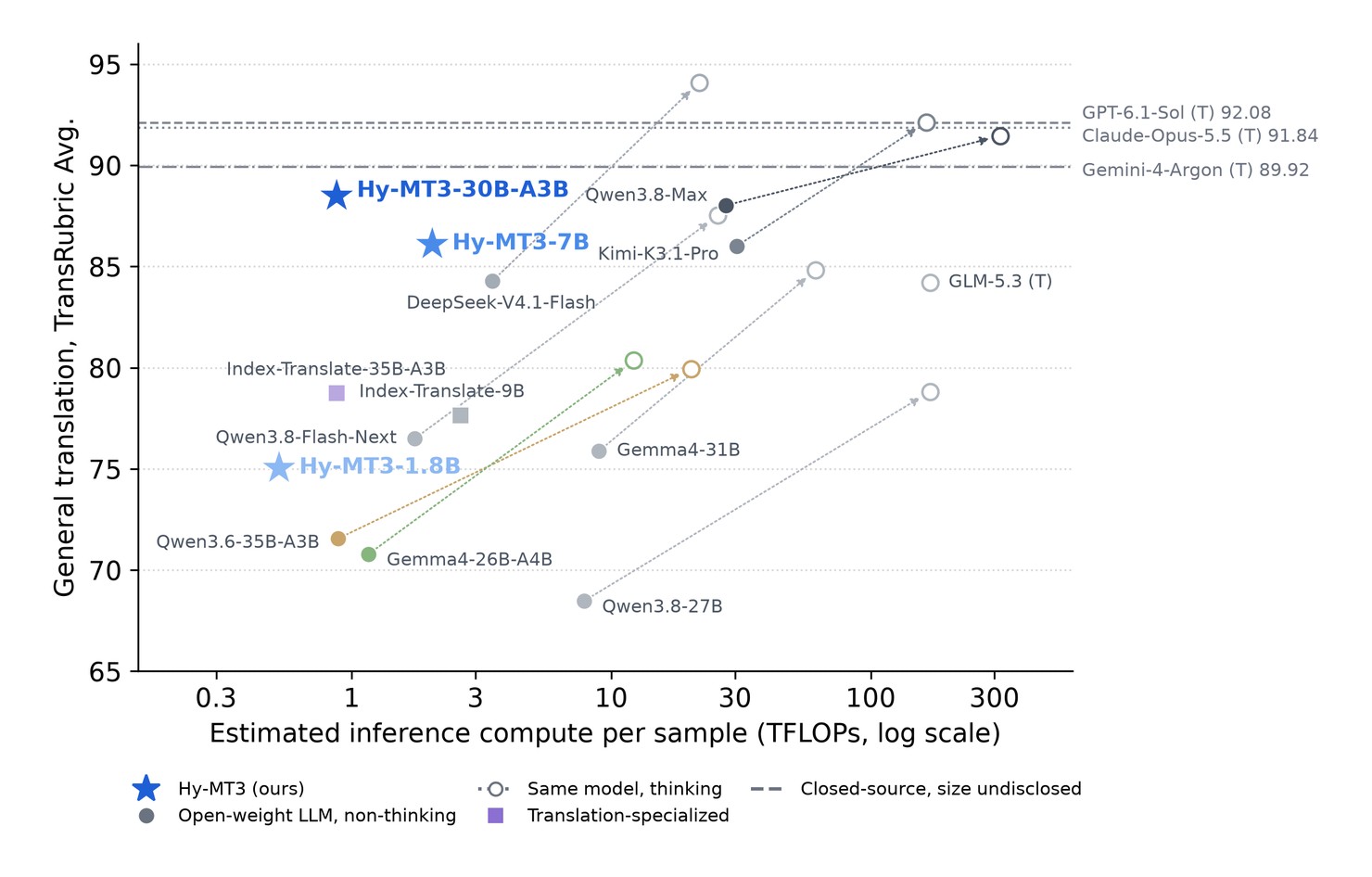
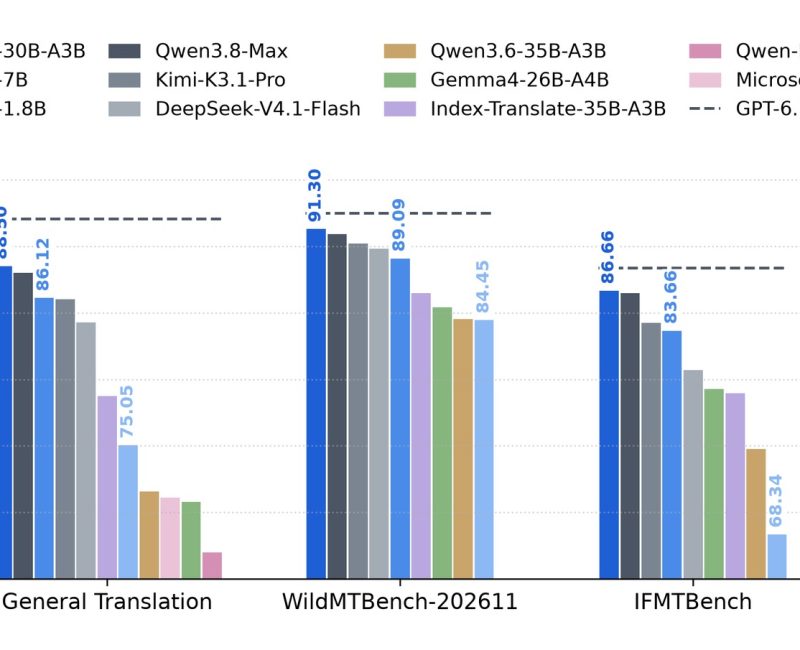
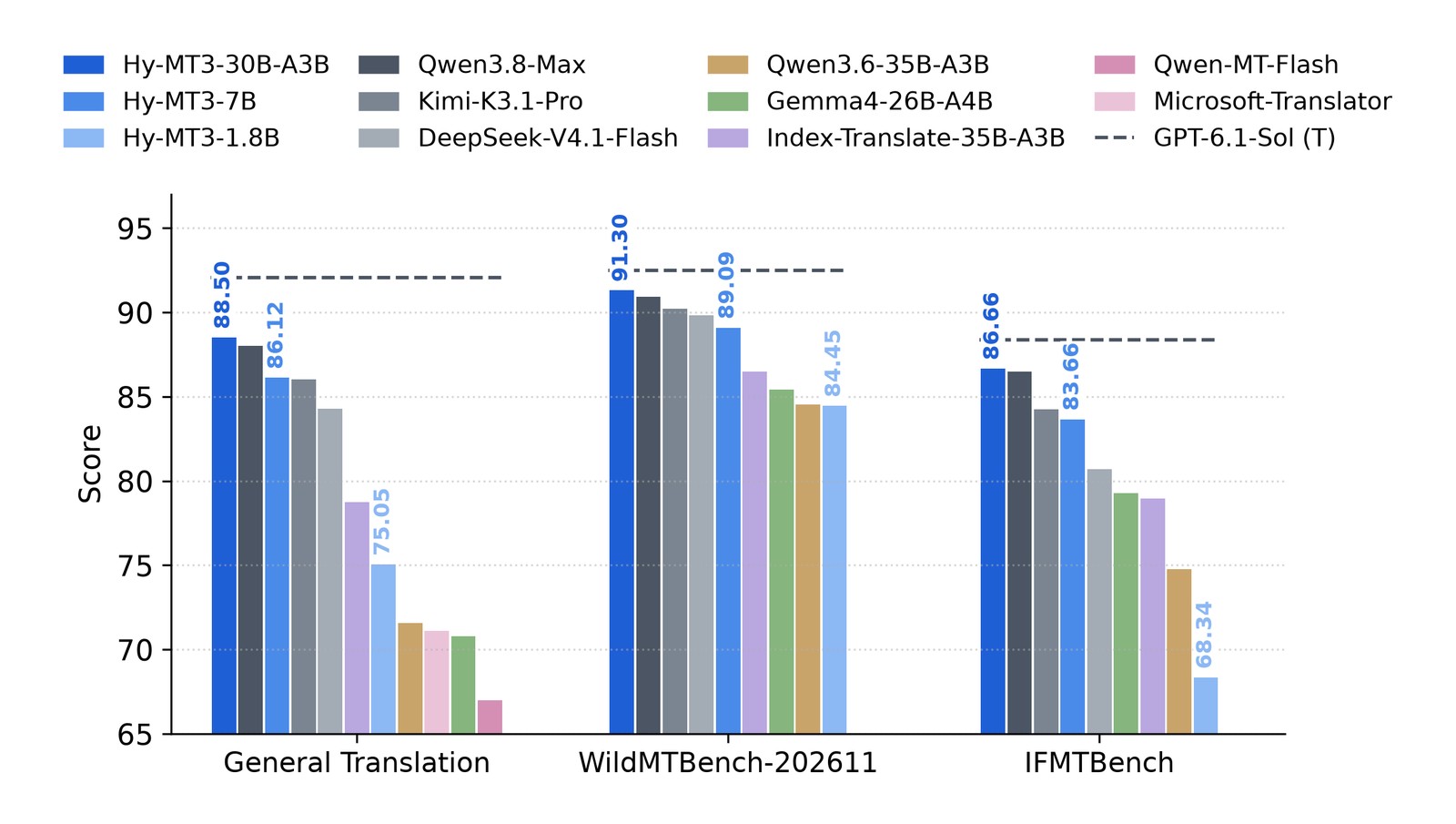
Tencent’s broader claims are bold. According to the model card, the 30B-A3B posts the best overall score of every model it tested in non-thinking mode, including much larger flagships like Qwen3.8-Max and Kimi-K3.1-Pro, while using a fraction of the compute. Versus Hy-MT2, it says the share of real-world samples with mistranslations fell 43 percent, omissions or additions fell 74 percent, and instruction-following errors fell 40 percent. Even the tiny 1.8B, it says, beats Microsoft Translator and Qwen-MT-Flash on general translation.
Here’s the tradeoff. The General Translation and WildMTBench scores are graded by TransRubric, an LLM-as-a-judge suite that Tencent built and is open-sourcing alongside the models. According to the report, the scores are averaged across two outside judge models, DeepSeek-V4.1-Flash and Qwen3.5-397B-A17B, and Tencent says TransRubric did well in the WMT26 shared task on automatic translation evaluation. Releasing the rubrics so others can check the work is the right move. Still, a vendor grading its own model with its own grading system is the definition of a company claim, and the game localization test was co-designed with Tencent’s own studio. Independent testing on your own language pairs is the only number that really counts. ByteForward’s early write-up makes a similar point.
The report is also refreshingly honest about quantization. For the 7B, the FP8, Q8 and Q4_K_M builds stay within 0.6 points of full BF16 on every benchmark, and the 30B-A3B stays within 0.4 points. The 1.8B is touchier: at Q4_K_M, its low-resource FLORES-200 score drops from 75.44 to 72.89. If you care about smaller languages and you’re on modest hardware, the 7B at Q4 looks like a smarter pick than squeezing the 1.8B.
Cody’s take
I like this release a lot, mostly because it’s aimed at a problem real people have. Specialized models that do one job well are exactly where local AI shines, and translation is a perfect fit. You can run it offline, there are no per-character API fees, and nothing you paste in leaves your machine. The Apache 2.0 license, with no extra restrictions in the license file, means modders, fan translators and small studios can build on it without a lawyer.
I’m not ready to call it better than the big closed models, though. The benchmark wins come from Tencent’s own rubric, the 8K context limits how much you can throw at it at once, and the release is barely a day old, so independent testing hasn’t caught up yet. My plan is to throw game text at the 7B Q4 in languages I can actually sanity-check, and if you’re a translator or a modder, I’d suggest doing the same with yours. And if Hy-MT3 really keeps game tags intact as well as Tencent says, the next unofficial patch for that import-only RPG on your backlog might get a lot easier to make. Grab the files from GitHub or Hugging Face, and read the report before you trust the charts.
Author