KRAFTON is best known for dropping 100 players onto an island in PUBG: Battlegrounds, so it’s a little wild to see the same company shipping one of the more interesting open AI models of the week. On November 25, KRAFTON released the full version of Raon-1 mini, a language model it built and trained in-house, and put the weights on Hugging Face under the Apache 2.0 license. That means anyone can download it, tweak it and use it commercially.
The headline number for local AI fans: with KRAFTON’s NVFP4 build, the model can run a full 256K-token context on about 20 GiB of VRAM. That puts long-context work within reach of a single 24GB graphics card instead of a server rack. There are real caveats, though, and most of them come down to software support that isn’t in the mainstream tools yet.
What’s inside Raon-1 mini
KRAFTON calls Raon-1 mini a “30B-A4B” model, and the official model card gives the exact figures: 28.8 billion total parameters, with 4.3 billion active for each token. It’s a mixture-of-experts design with 128 routed experts. Six of them plus one shared expert fire for each token, which is why it runs much faster than its total size would suggest.
The memory trick comes from how attention is handled. Only 7 of the model’s 25 layers use a traditional KV cache (multi-head latent attention, a compressed style popularized by DeepSeek). The other 18 use what KRAFTON calls Raon Delta Attention, a linear-attention variant that keeps a fixed-size state no matter how long the conversation gets. KRAFTON says it’s derived from Kimi Delta Attention, with separate erase and write gates. In practice, the part of memory that usually balloons with context length grows much more slowly here. The card puts the KV cache at about 8 KiB per token in BF16, or roughly 2 GiB for a maximum-length 262,144-token request.
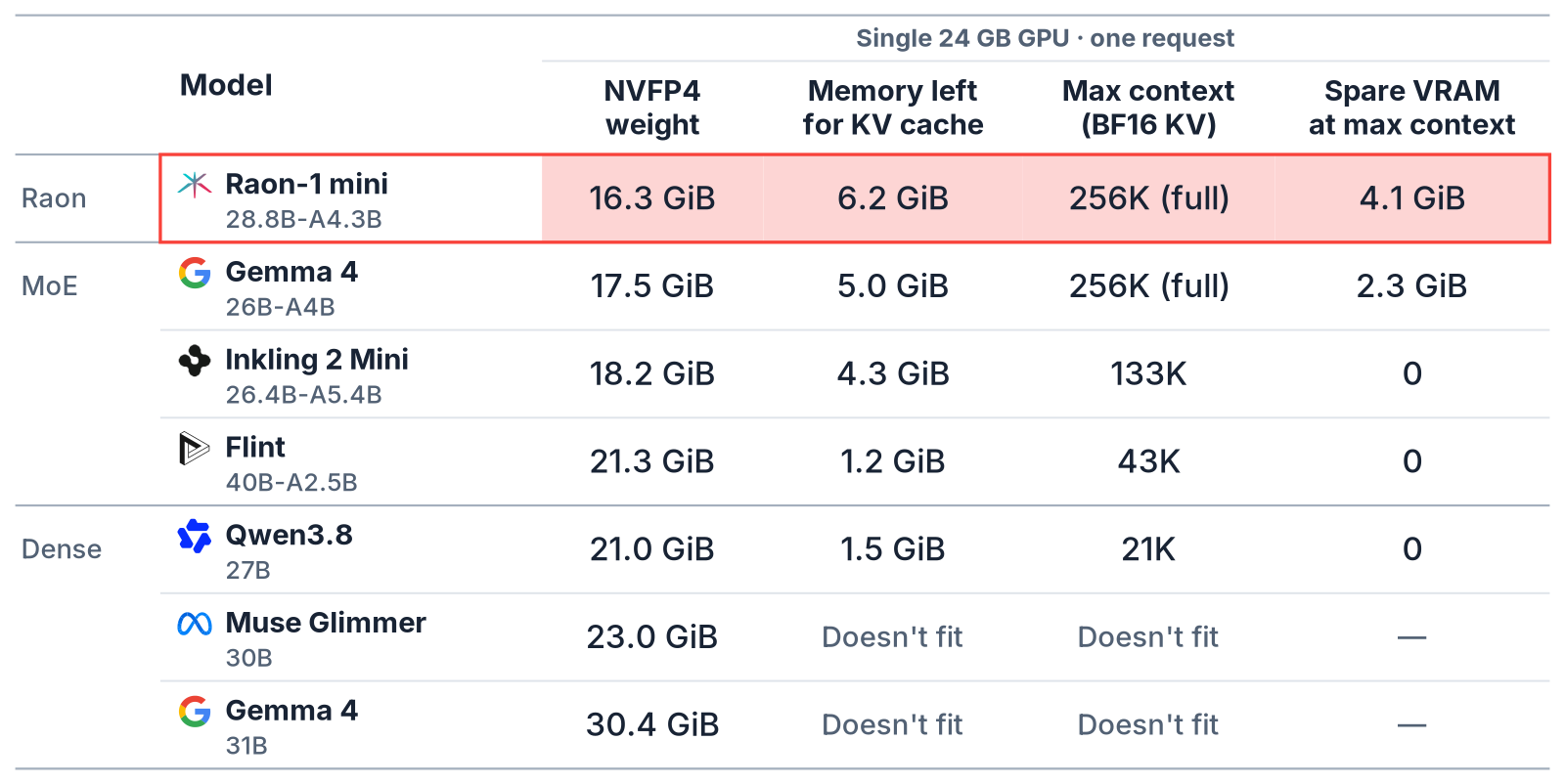
KRAFTON’s own memory table shows the NVFP4 weights at 16.3 GiB. That leaves room for a full 256K context on a 24GB card with about 4 GiB to spare. In the same chart, Inkling 2 Mini tops out around 133K tokens on that card and Qwen3.8 27B at about 21K. Those are KRAFTON’s calculations from each model’s config, not independent measurements, but the architecture explains why the gap exists.
Other features are aimed at agent work. There are six reasoning-effort levels, from none (answer immediately) through low, medium, high (the default), xhigh and max. You set them per request, and KRAFTON says they’re implemented with steering vectors that ship inside the checkpoint rather than with prompt tricks. Tool calling is supported, with setup notes for Hermes Agent, Pi and OpenCode. KRAFTON also released a small DFlash2 draft model for speculative decoding. The model was trained on seven languages: Korean, English, Japanese, Chinese, Spanish, French and Thai. KRAFTON is open about Korean being the priority and describes the English as “solid.”
The benchmarks, read honestly
KRAFTON’s comparison chart pits Raon-1 mini against Qwen3.6 35B-A3B, Gemma 4 26B-A4B, Flint and Inkling 2 Mini, with two dense models shown for reference. Raon leads that MoE group on MultiChallenge, a multi-turn instruction-following test, at 64.9. That’s 5.9 points better than the October preview, according to KRAFTON. It also leads on BrowseComp Plus (55.9) and GDPval (72.3). Its reasoning scores are strong for the size too, with 96.7 on AIME 2026 and 86.0 on GPQA Diamond.
Look past the highlighted cells, though, and it doesn’t win everything. In KRAFTON’s own table, Inkling 2 Mini edges it on AIME 2026 (97.5) and GPQA Diamond (86.6) and clearly beats it on the AA-LCR long-context test (80.7 vs. 70.7). That’s notable for a model whose big pitch is long context. On LiveCodeBench v6, Raon’s 81.7 trails both Flint (88.5) and Inkling 2 Mini (87.4). Flint also tops it on IFBench. Every one of these numbers is self-reported. Some of them were graded by an AI judge, and the Korean chatbot score comes from an internal benchmark that isn’t public. Treat the chart as a guide to where to start testing, not a final verdict.
The bigger practical hurdle for home users is software. Raon-1 mini’s new attention layers aren’t supported in stock tools yet. The GGUF release requires building KRAFTON’s own llama.cpp branch, and the card says upstream support is “pending.” The vLLM route also uses a KRAFTON fork and needs CUDA Toolkit 13. KRAFTON says it tested that path on NVIDIA’s B300 data center GPU Its consumer RTX 5090 profile caps context at 32K tokens. NVFP4 itself is an NVIDIA Blackwell format. Apple silicon owners get an official MLX build. If you’re on a Radeon or Intel card, the build notes only cover CUDA and Apple, so expect some trial and error. LM Studio and Ollama users should wait until llama.cpp support lands upstream.
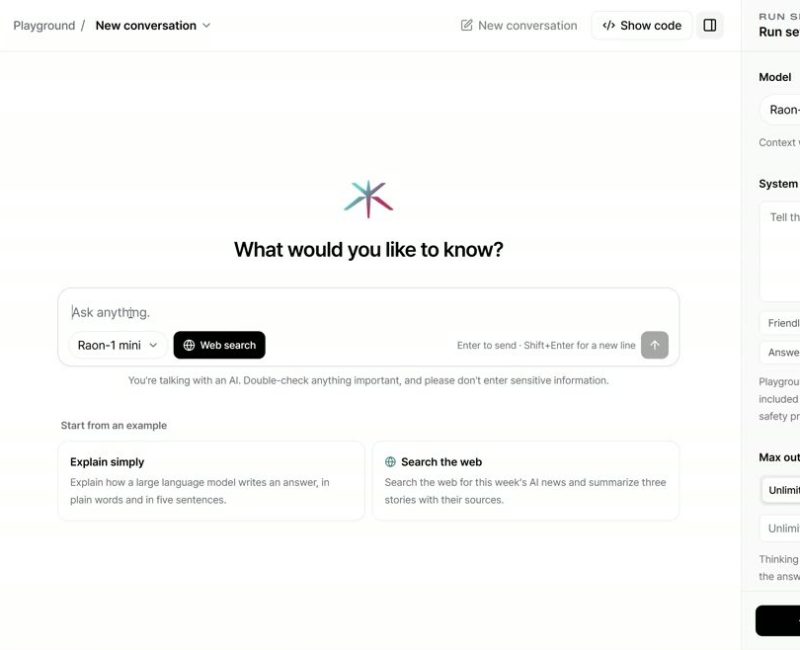
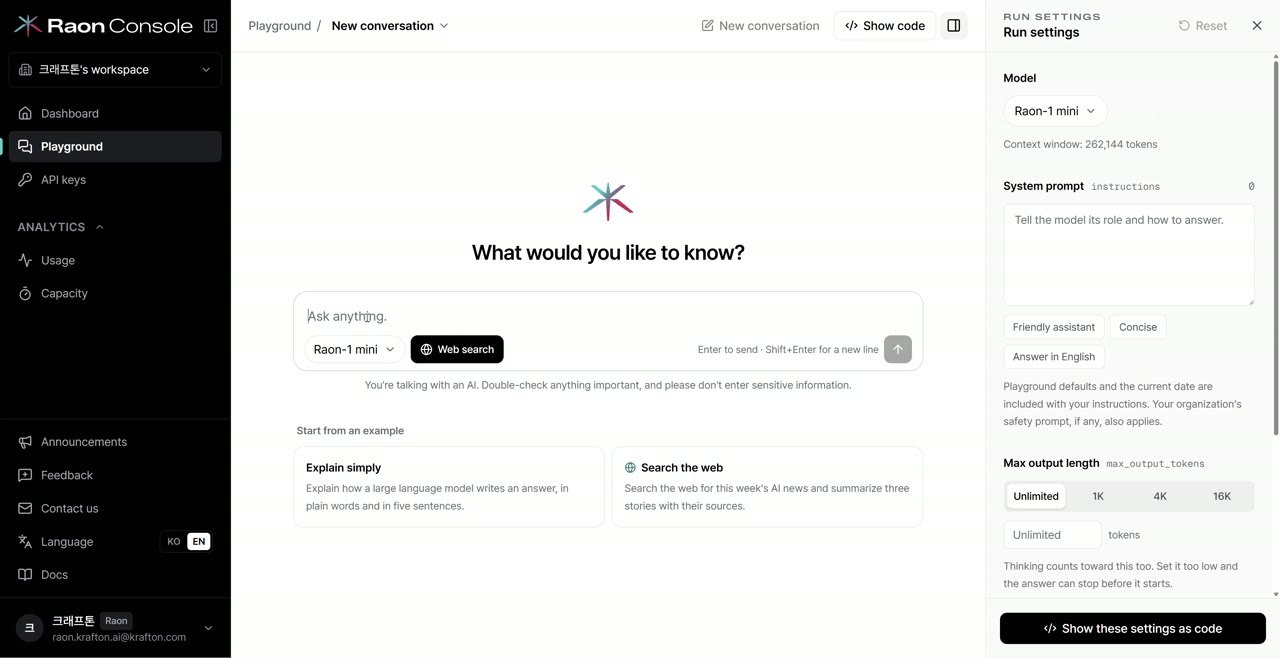
If you do want to try the GGUFs, file sizes run from 15.1 GiB for IQ4_XS and 18.3 GiB for Q4_K_M up to 28.6 GiB for Q8_0. Q4_K_M with a long context is a comfortable fit on a 24GB card. On 16GB, you’re looking at IQ4_XS and a much shorter context. Without a capable GPU, you can use the browser Raon-1 mini playground, which the model card says is free “for a limited time.” The model card points out that the hosted API and playground are not covered by Apache 2.0. They have their own terms, which reserve KRAFTON’s right to charge fees later. The downloadable weights are the part that’s truly open.
Cody’s take
I grew up on a PS2 thinking of game companies as the people who made the thing in the disc tray, so watching a publisher ship a from-scratch language model with its own attention design still feels new. It isn’t coming out of nowhere, though. KRAFTON AI’s site already shows AI teammates it calls co-playable characters in PUBG and inZOI, and the company launched its Raon model brand in April with speech and vision releases. Its chief AI officer, Lee Kang-wook, said in The Financial News that KRAFTON will keep building “models that can be applied across a range of industrial settings,” with a larger Raon-1 and a real-time two-way voice model planned next.
What I like most is that the efficiency claim is backed by an architecture you can actually inspect, under a license with no strings on the weights. A 256K context on one 24GB card is a genuinely useful idea for anyone who wants to drop a whole codebase, a long design doc or a stack of patch notes into a local model. What’s holding it back today is tooling. Until the llama.cpp changes land upstream, this is a model for tinkerers comfortable compiling forks, not a one-click download. If you’re fine with that, it’s one of the more interesting open releases of November. If you’re not, bookmark it and check back once your favorite app supports it.
Author