Alibaba’s Qwen team just shipped its biggest model yet, and the headline numbers are huge. Qwen4-Max went generally available on Monday, November 16, with 2.4 trillion total parameters, native image and video understanding, a one-million-token context window and lower API prices than the model it replaces. The detail that matters most if you run models on your own hardware is a different one, though: you can’t download this one.
That’s a real change in direction for a model family that built much of its reputation on open weights. Qwen4-Max is hosted only, available through Alibaba’s QwenCloud API and Token Plan and inside Alibaba’s own apps. Alibaba says smaller Qwen4 models will get open weights “soon,” but it hasn’t given names, sizes, a license or a date.
The model has been around in some form for a few days. According to QwenCloud’s model changelog, a Qwen4-Max-Preview opened on November 11 for Token Plan subscribers only, and the full qwen4-max model, with tool calling, structured outputs, explicit caching and chain-of-thought summaries, showed up on the 16th.
What’s actually new under the hood
Qwen4-Max is a sparse mixture-of-experts (MoE) model, meaning only a slice of the network fires for each token. Alibaba’s press release puts it at 2.4 trillion total parameters with 71 billion active per token. That’s the same total size as Qwen3.8-Max, but with 25% fewer active parameters, which is where a lot of the claimed efficiency comes from.
The Qwen team’s technical write-up, as summarized by MarkTechPost and The New Stack, says the Qwen4 architecture changes three things. Attention now mixes Gated DeltaNet layers, which squeeze history into fixed-size states, with a new Qwen Sparse Attention layer that picks out the relevant chunks of long context. There’s a gated residual design with four parallel branches meant to keep training stable at this scale. And there’s an extra 328 billion parameters of “N-gram Embedding,” a lookup table for common local token patterns that adds capacity without adding much compute. Max output is listed at around 393K tokens, which is enormous for a single response.
If you’ve been following linear-attention research, the DeltaNet piece is the interesting part. It’s the same family of ideas that makes very long contexts cheaper to serve, and seeing it in a flagship from one of the biggest labs is a sign it has moved well beyond research papers.
The benchmarks are mixed, and the best ones are Alibaba’s own
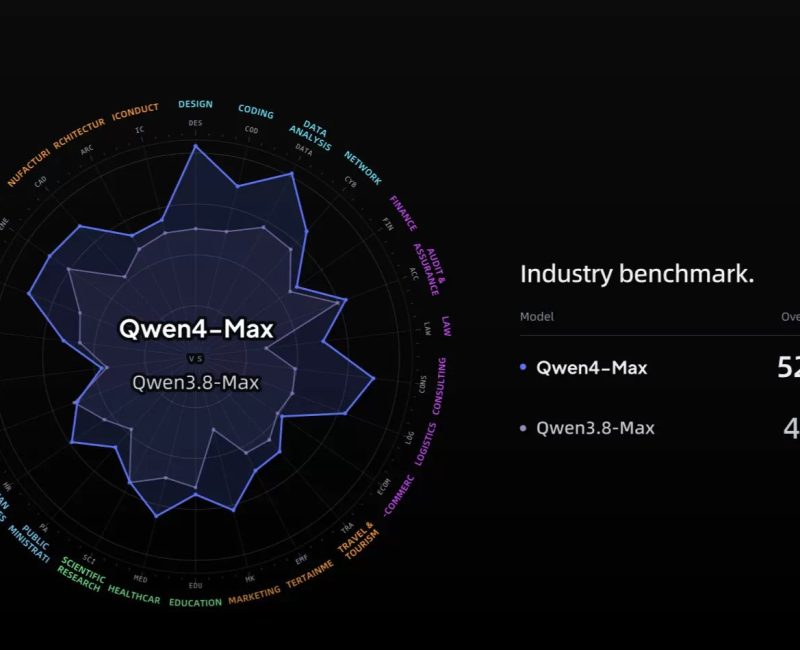
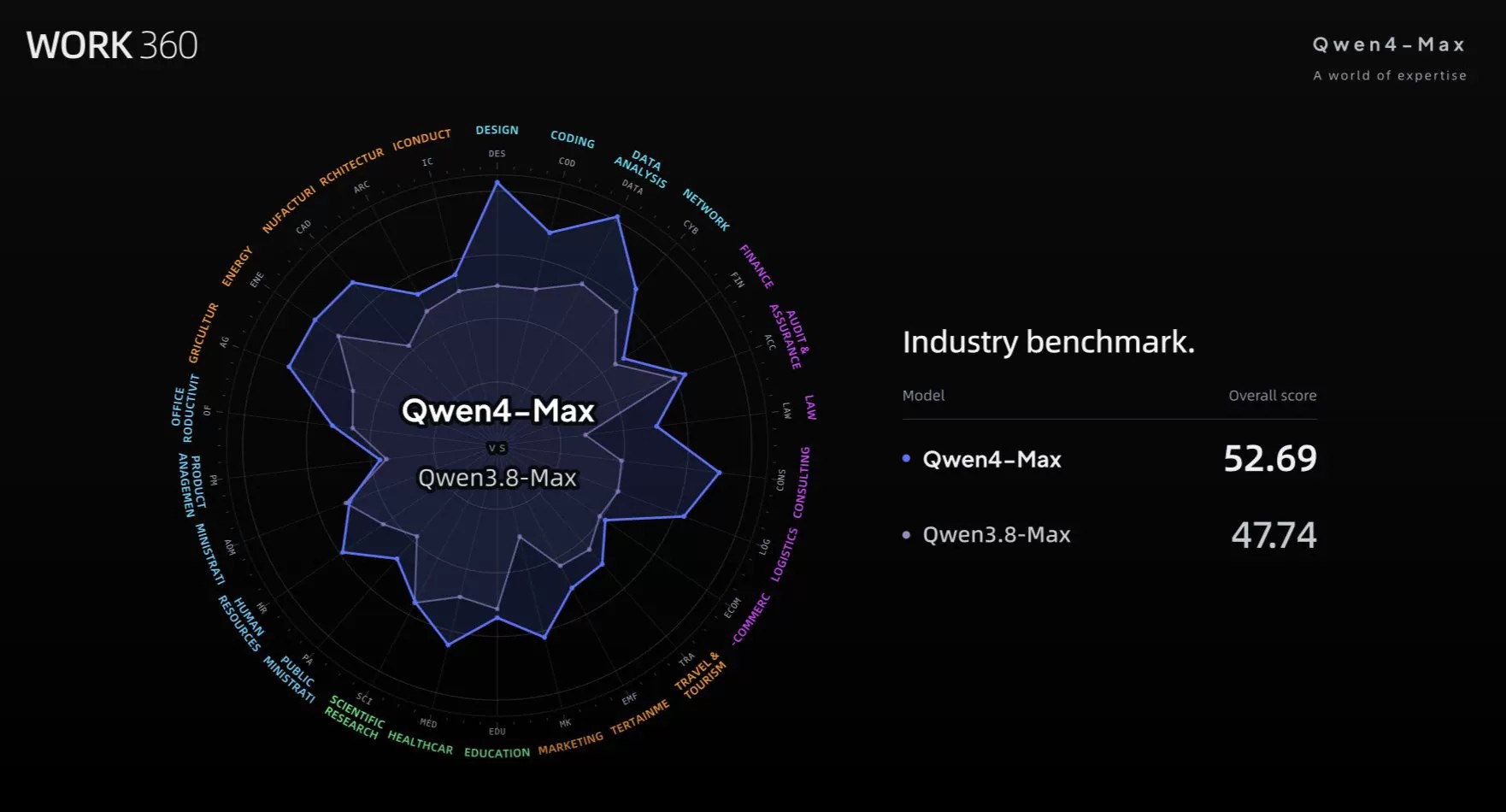
Alibaba’s pitch is efficiency as much as raw smarts. On Work360, its in-house benchmark covering 721 specialized professional fields, Qwen4-Max scores 52.69 against 47.74 for Qwen3.8-Max. The company says it gets there with 24% to 35% fewer tokens depending on the reasoning-effort setting, and that fewer tokens plus lower prices cut the average cost per Work360 task from $4.43 to $1.67, roughly 62%. The press release also says the model ranked 6th on the Code Arena coding leaderboard.
The obvious caveat: Work360 is Alibaba’s test, run by Alibaba. In the broader comparison chart covered by MarkTechPost, Qwen4-Max takes first place on 4 of 16 benchmarks, including legal-agent work and Agents’ Last Exam, and edges out rivals on the DeepSWE v1.1 coding test with 75.7. It falls well behind on others. On ProgramBench it scores 31.5, and on Terminal-Bench 4.0 it scores 48.5 while Moonshot’s Kimi K3.1 posts 67.2, per The Next Web. None of these vendor-run scores had been independently reproduced at launch.
The closest thing to an outside view so far comes from Artificial Analysis, which, according to The New Stack, gave Qwen4-Max a 43 on its Intelligence Index. That’s 38th out of 81 models, a little above the median for its price bracket but well behind the top closed models from Anthropic, Google and OpenAI. The same testing found Qwen4-Max fairly chatty, generating about 127 million output tokens across the evaluation suite versus a median of 78.6 million, at an average cost of $3.27 per task. So the “uses fewer tokens” story holds against its own predecessor, not necessarily against the rest of the field.
Pricing, at least, is straightforward. Per The Next Web, The New Stack and MarkTechPost, the API starts at $1.50 per million input tokens and $4.50 per million output tokens, down from $2 and $6 for Qwen3.8-Max. Alibaba’s press release lists cached input at $0.075 per million tokens. Besides QwenCloud, the model is in Qwen Studio, QwenWork and the Qoder coding app, and The New Stack reports Vercel has added it to its AI Gateway.
Alibaba is also leaning on long-running agent demos. It says Qwen4-Max ran a 48-hour, four-round closed loop of molecular design and lab testing that turned up an experimentally validated chip coolant molecule, and that in an Alzheimer’s research test it made 454 tool calls to design 24 candidate molecules. Those are interesting showcases, but they’re the company’s own accounts, not peer-reviewed results.

Why the closed weights sting for local AI
For the local AI crowd, Qwen has been a go-to family for years: lots of sizes, permissive licenses and fast community quantizations. And the open approach had just reached the top of the lineup. When Alibaba introduced Qwen3.8-Max in August, it promised to release the weights of a flagship Max model for the first time, and The New Stack notes it followed through on August 12 with Qwen3.8-2.4T-A95B, though under a custom license rather than Apache 2.0.
Qwen4-Max goes back to the older playbook, where Max models like Qwen3.6-Max-Preview and Qwen3.7-Max stayed proprietary. Practically, that means no GGUF builds, no running it on your own rig, and no fine-tuning. To be fair, a 2.4T model was never going to fit on a gaming PC or a single workstation card even with aggressive quantization, so most home users lose very little today. The bigger question is the smaller Qwen4 models Alibaba promised. If they bring the new attention and embedding design to sizes that do fit on consumer GPUs, under a real open license, that will matter far more to local AI than the Max model ever could.
There’s a safety angle in the announcement too. Alibaba says it filtered training data by intent, keeping defensive security material like vulnerability detection while dropping offensive attack content, and added post-training aimed at chemical, biological, radiological and nuclear risks. That’s welcome, but it’s also the kind of claim that’s hard to check from outside when the weights stay locked up.
Cody’s take
Qwen4-Max looks like a serious, cheaper flagship. If you already build on Qwen’s API, a price cut plus a million-token window is good news, and the architecture work is worth watching. But the strongest numbers come from Alibaba’s own benchmark, independent scoring puts it in the middle of the pack, and for anyone who chose Qwen because they could own the weights, this release has nothing for you yet. I’m much more interested in the smaller open Qwen4 models than in the Max launch. Until Alibaba puts a date, sizes and a license on those, I’d treat that promise as a maybe.
Featured image: Qwen4-Max Work360 benchmark chart from Alibaba’s official press release, Image: Alibaba Group. Headquarters photo by Thecraft via Wikimedia Commons, CC BY-SA 3.0.
Author