


Patch day has always had an awkward gap in the middle. A critical bug goes public, the fix lands upstream, and then everyone running real servers waits. They wait for packages, for testing, for a maintenance window, and sometimes for a reboot nobody wants to schedule. On Monday, OpenAI and Cisco announced an open-source project built to cover exactly that stretch of time. It’s called Shirudo, which is Japanese for “shield,” and it loads small, signed protections into a running Linux system so a known exploit path gets blocked before the permanent patch arrives.
The idea is smart and the engineering looks serious. But the GitHub README calls the project pre-release, and the requirements list is long. So this is one to watch and maybe tinker with in a VM, not something to roll onto your home server tonight.
What Shirudo actually does
At its core, Shirudo is built on eBPF, the Linux kernel feature that lets small, verified programs run at specific hook points inside the OS without changing kernel source or rebooting. If you’ve ever used tools like bpftrace or Cilium, you’ve already touched eBPF. Shirudo uses it to ship what the project calls “upatches,” or shields. They’re tiny, targeted mitigations that can block a vulnerable code path in the kernel, watch for suspicious behavior, or enforce a hardening policy on containers and AI agents.
According to OpenAI’s announcement, operators can test a shield first to see whether it stops the bad behavior while letting legitimate traffic through. Then a human signs off before it goes live. That approval step matters, because the pitch here is AI agents doing the grunt work: reading a vulnerability report, reproducing the exploit, writing the mitigation and checking that it holds up.

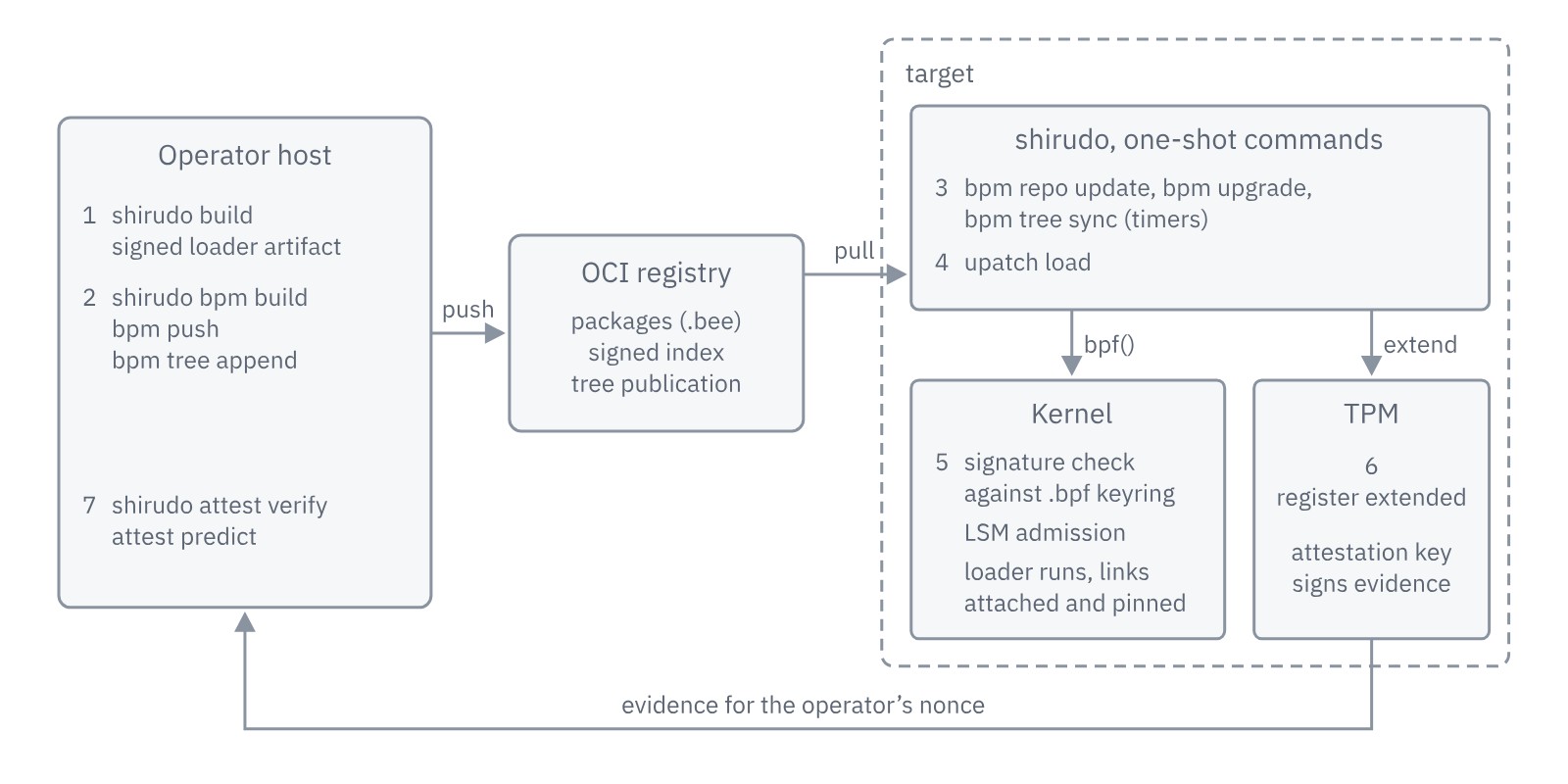
The trust model is where it gets interesting. Every shield is cryptographically signed, and the project FAQ says signing uses ML-DSA-87, a post-quantum algorithm, with no option to bring your own legacy key. After boot, Shirudo only allows BPF programs that come through signed loaders, which means even root can’t load unsigned BPF or switch off enforcement without the operator’s signing key. A TPM 2.0 chip records every change to the loaded shield set, so an operator can verify after the fact exactly what was running on a machine. There’s no always-on daemon and no open port. Targets pull signed .bee packages from an OCI registry using one-shot commands, run by hand or on a systemd timer.
Cisco’s piece of the puzzle comes from Isovalent, the eBPF company it bought. In Isovalent’s technical write-up, Thomas Graf and Liz Rice describe Shirudo as a rewrite of Tetragon, their eBPF security tool that went open source in 2022. Their reasoning is that agents work better writing code directly than wrestling with policy languages designed for humans. Shirudo also isn’t limited to eBPF. It can inject guards into application bytecode, too, and that’s exactly how the headline demo worked.
The Java4Shell demo, and the fine print
The showcase target was Java4Shell, a nasty OpenJDK bug tracked as CVE-2026-114938. Per Red Hat’s security bulletin, the flaw sits in the Base64 decoder of OpenJDK 17.0.6 and later. It only bites on x86-64 CPUs with AVX-512 VBMI, where the JVM automatically picks an accelerated code path, and malformed input can corrupt memory and lead to remote code execution. Base64 is everywhere in auth flows, so attackers can often reach it before anyone logs in. Red Hat’s interim workaround is a JVM flag, -XX:-UseBASE64Intrinsics, but adding a flag means restarting the service.
Shirudo’s team took a different route. Using OpenAI’s Codex as the agent, they generated a shield that adds an input check to Java’s Base64 decoder. Then they attached it to a running Elasticsearch 9.5.5 instance without a restart. Isovalent’s post includes the Elasticsearch log lines showing the guard installing and then rejecting a malformed input. Cisco’s press release says the system also produced code that detected and blocked attempts to exploit a recent PHP flaw.

Now for the fine print, and there’s a lot of it. Shirudo can’t run on the kernel your distro ships today. The system requirements page says targets need a bpf-next kernel with a new signed-loader ABI, plus several carried patches, including new LSM hooks. It also flatly states there is “no compatibility mode and no fallback for an older kernel.” A TPM 2.0 is mandatory, too. And because only signed loaders are allowed, the FAQ notes that tools like Cilium, Falco and bpftrace won’t run on a protected machine as they are. Their logic would have to be repackaged as signed upatches. CI fully tests x86-64, arm64 is partway there, and the FAQ says no riscv64 target has booted yet.
Shirudo also isn’t trying to replace updates. The FAQ is blunt that a shield only covers the time until a machine runs a kernel with the real fix. The docs also admit that an attacker who already has a way into the kernel itself, like a kernel exploit or a module signed with a trusted key, gets around every check that kernel makes.
Some security folks are already uneasy about the AI angle. BleepingComputer highlighted comments from Expel’s Marcus Hutchins. He agreed eBPF has huge potential for runtime exploit mitigation but questioned whether AI agents should be writing rules that touch the kernel. He also pointed out the approach is Linux-only for now, since macOS and Windows lack the needed building blocks. That’s a fair concern. The project’s answer is the signing, verification and human approval layers, but those are only as good as the people and processes behind them.
Cody’s take
I like this a lot as a direction, and I’m glad it’s open source from day one. It’s BSD-2-Clause, with the BPF programs dual-licensed BSD and GPL. The goal OpenAI describes, shipping tested shields alongside vulnerability disclosures, would be a real upgrade for anyone stuck between “critical CVE dropped” and “we can’t reboot production until Sunday.” Building trust on TPM measurement and post-quantum signatures, instead of hoping a root shell never happens, is the right instinct.
But let’s be clear about who this is for right now. It’s for kernel developers, security researchers and infrastructure teams who are comfortable running patched bpf-next kernels in a lab. For most homelab folks and Linux desktop users, the practical moves on Java4Shell and every other bug are still the boring ones: update your packages, apply vendor workarounds, and reboot when the new kernel lands.
If you’re curious, the VM quickstart uses a software TPM, so you can sign, load and verify a test shield without special hardware. The project’s Linux Plumbers Conference talk is a solid primer, and OpenAI says a technical deep-dive webinar is set for December 15. I’ll be watching whether the kernel patches Shirudo depends on make it upstream, because that’s what decides whether this stays a cool lab project or becomes something your distro ships.

