


Bazzite 45 is out, and the timing is almost too clean. Hours after Fedora Linux 45 finally shipped, Universal Blue pushed its first stable Bazzite images built on that release. The official announcement went up November 3, GitHub tagged 45.20261103 the same evening, and by November 4 the usual Linux gaming sites had already picked it up.
If you just want a desktop that boots into Steam and mostly gets out of the way, this is the update that matters more than Fedora’s own. Bazzite is Universal Blue’s gaming-focused atomic image: Flatpaks for apps, a whole-image update model instead of a classic package upgrade, and a pile of handheld and controller work on top of Fedora’s Atomic Desktop bases. Version 45 is the first stable build on Fedora 45, and the headline feature is not a new desktop theme. It is a readiness check for Epic’s rebuilt Easy Anti-Cheat on Linux.

That is the right priority. Single-player Proton titles already look great on a lot of Linux setups. Competitive multiplayer is still the wall a lot of people hit, and Epic’s October plan to bring Fortnite and other EAC titles over is the clearest crack in that wall all year. Bazzite 45 does not unlock Fortnite today. It does put Universal Blue’s signing key on Epic’s well-known list and gives you a command that tells you whether your machine already meets the published rules.
Fedora 45 under the hood, handhelds on the surface
Under the hood, this is a big jump. Desktop choices move to GNOME 51.1 or KDE Plasma 6.8.2. The Open Gaming Collective kernel lands at 7.2.15 on the main images, with NVIDIA LTS images on 6.18.60. Mesa is at 26.2.6. Those numbers match what GamingOnLinux and Linuxiac reported against the official changelog, and they are the kind of stack bump that usually shows up as smoother Proton sessions and fewer “why is this shader compiling forever” evenings.
Hardware support is where Bazzite earns its keep for a lot of people. Initial InputPlumber support for the Acer Predator Atlas 8 is in, including Quick Access Menu tap actions and M1/M2 rear-button mappings. ROG Ally X20 support has moved onto the stable channel after a testing stretch, though the team is still chasing a custom TDP issue on the testing branch. Logitech TrueForce racing wheels get broader out-of-the-box support. The extest library that helps Steam Input under Wayland now covers the 64-bit Steam Beta client.
There are quieter quality-of-life fixes too. Optional bpftune and bpfrag services can tune the network stack for gaming. Btrfs maintenance shows up in the Btrfs Assistant GUI. CoolerControl installs through the project’s official Docker container instead of layered packages. KDE images drop XWaylandVideoBridge, which the maintainers say cleans up a whole class of bugs. Image chunks are now ZSTD-compressed with Chunkah in the build path, and Universal Blue claims incremental updates can land around 100 MB when the diff is small. For an atomic image that used to feel chunky to download, that is a real habit change.
One caveat that matters before you rebase: this crosses a Fedora major version. Universal Blue’s own guidance is to pin your current deployment first. Images stick around for about 90 days, but rolling back across a big jump has bitten people before when session management changed. If you are already on Bazzite 44, treat this like a real upgrade, not a Tuesday refresh.
The anti-cheat checker, and the warnings that come with it
Epic’s Easy Anti-Cheat Linux v2 announcement from mid-October is the other half of this story. Instead of a Windows-style kernel driver, EAC v2 leans on signed kernels and modules, Secure Boot with well-known keys, TPM 2.0, measured boot, IOMMU, kernel lockdown in integrity mode, a disabled kexec path, and the BPF LSM. A temporary systemd service starts with a protected game and stops when you quit. Epic plans to pilot it in Fortnite first, then open it to more titles. Universal Blue is already on Epic’s published well-known key list alongside Fedora, Ubuntu, Debian, openSUSE and others.

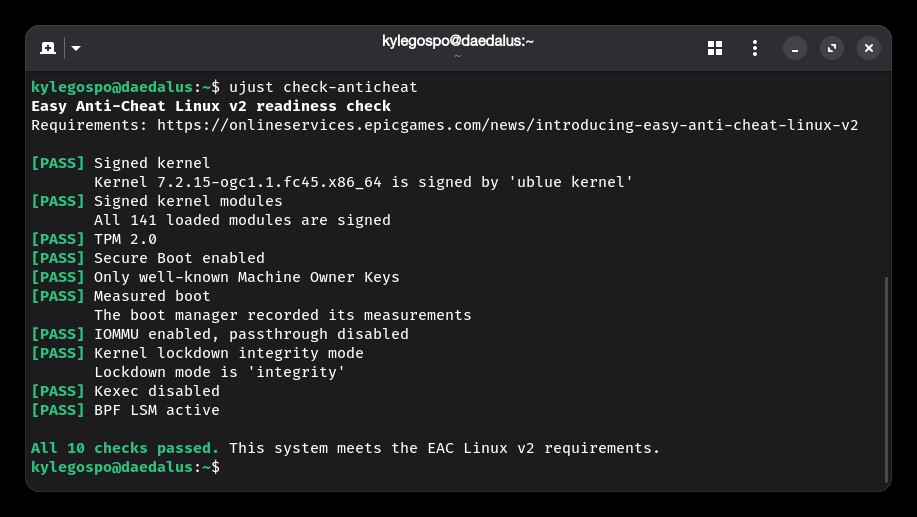
ujust check-anticheat results. Image: Universal Blue / BazziteBazzite 45 wraps that checklist into ujust check-anticheat. Run it and you get pass/fail results plus tips. It does not flip Secure Boot for you, does not enable lockdown, and does not install Epic’s anti-cheat service. It just tells you where you stand against the published requirements. That is the right tone. The requirements are strict enough that a silent auto-config would be a bad idea.
Two warnings from the Bazzite team are non-negotiable right now. Handheld users should not enable kernel lockdown yet while the project works on a better path. Steam Deck users must not enable Secure Boot; Epic’s own FAQ already says the Deck does not meet EAC v2’s requirements today, and Bazzite says it will announce when that changes. If the checker nags you toward those switches on a Deck or another handheld, ignore it for now and wait for maintainer guidance.
That honesty is useful. Fortnite on Linux is coming according to Epic, but there is still no consumer launch date, and a readiness tool is not the same thing as a playable client. Desktop PCs with TPM 2.0, working Secure Boot and a signed kernel stack are in the best position. Handhelds and Decks are still waiting on hardware, firmware and distro work that has not finished.
Cody’s take
I like what Bazzite 45 is actually saying. Fedora 45 underneath keeps the graphics and desktop stack current. The handheld work keeps expanding beyond Steam Deck clones into things like the Atlas 8 and Ally X20. The anti-cheat checker is practical without overselling: Epic put Universal Blue on the key list, Bazzite gave players a way to audit their box, and both sides are still clear that Fortnite is not suddenly playable tonight.
The tradeoffs are real. Atomic images are easier to keep clean and harder to casually “apt install” your way out of a weird edge case. Major-version rebases can be sticky. EAC v2’s security list is going to feel invasive to people who treat their Linux box like a lab bench, and Epic is open about iterating on those rules. If your main machine is a Deck, this release helps a lot of other things and does nothing for Fortnite yet.
For everyone else who wants a gaming-first Fedora atomic setup, Bazzite 45 is the one to grab from bazzite.gg, or rebase to with the project’s usual rollback helper after you pin the old deployment. Run the anti-cheat check out of curiosity. Just do not flip Secure Boot or lockdown on a handheld because a terminal told you to. The point of this release is being ready when Epic is ready, not breaking the device you game on today.
Featured image: official Bazzite 45 release artwork from the Universal Blue announcement. Image: Universal Blue / Bazzite.

