


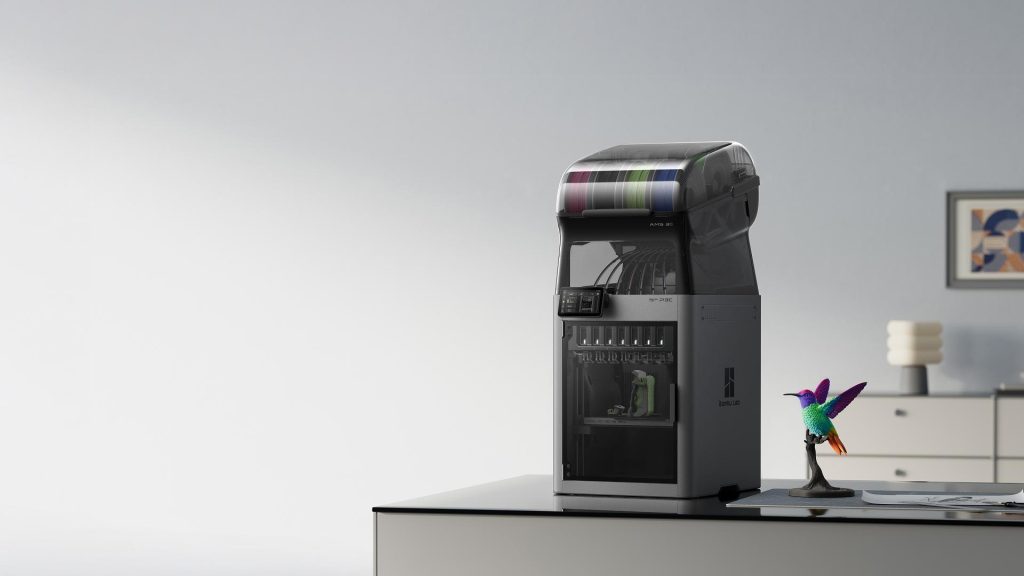
Bambu Lab just made its tool-changer pitch a lot easier to swallow. Today, November 24, 2026, the company launched the Bambu Lab P3C, a third-generation desktop printer built around the same Swaptek 7-tool system as the flagship H3C, at a much lower price. The standard P3C AMS Combo is $1,149 before tax, with free shipping in the United States, and it’s up for order now on the official U.S. store.
That sounds like a lot of printer for the money, and in some ways it is. The P3C can keep several materials loaded, pre-heat the next nozzle while the current one is still printing, and swap to the new material in as little as six seconds, according to Bambu Lab’s own testing. It also folds a seven-spool AMS 3P into the machine instead of parking loose holders on your desk. But the headline number needs a closer look. The printer has seven tool slots, and the $1,149 combo only fills five of them. The extra nozzles, soft-TPU tool, and workshop add-ons that make the marketing shots possible are sold separately.
What’s in the $1,149 combo, and what isn’t
The combo Bambu Lab is leading with includes the P3C, the integrated AMS 3P, and five 0.4 mm standard PrintTools. Two slots are left empty on purpose, so you can add a 2.85 mm TPU tool, more color capacity, or one of the optional CraftTools later. A textured PEI plate and an accessories box are also in the box.
The company says the P3C is available worldwide as of today. On the U.S. store, orders ship from a U.S. warehouse within one to three business days once they’re processed, with free shipping in the 48 contiguous states. One practical wrinkle, which Bambu Lab notes in its launch post: the printer and the AMS 3P go out in separate boxes and may show up on different days. The store also lists higher-end combos that add extra PrintTools, a 2.85 mm TPU tool, filament, the optional E1 air purifier, or the Bambu Station stand. I wouldn’t treat every bundle price you see in early coverage as gospel, because Bambu Lab’s own blog still shows a $1,269 figure next to the standard combo even as the U.S. store rings up $1,149. The store price is the one I’d go by.
A few other items are easy to miss. The included nozzles are all 0.4 mm hardened steel. If you want to mix 0.2 mm, 0.6 mm, or 0.8 mm tips in a single job, you need extra hotends. Bambu Lab is selling a multi-size hotend kit for the H3C and P3C at $147, marked down from $174.95. The optional two-slot drying module heats to 75°C for moisture-sensitive filament like TPU, PETG, nylon, and carbon-fiber blends, but it only covers two of the seven AMS slots. And automatic feeding is not available on the AMS 3P. Bambu Lab says there’s no official accessory for that, so check that against how you actually work before you order.
How the tool changer and FlexFeed work

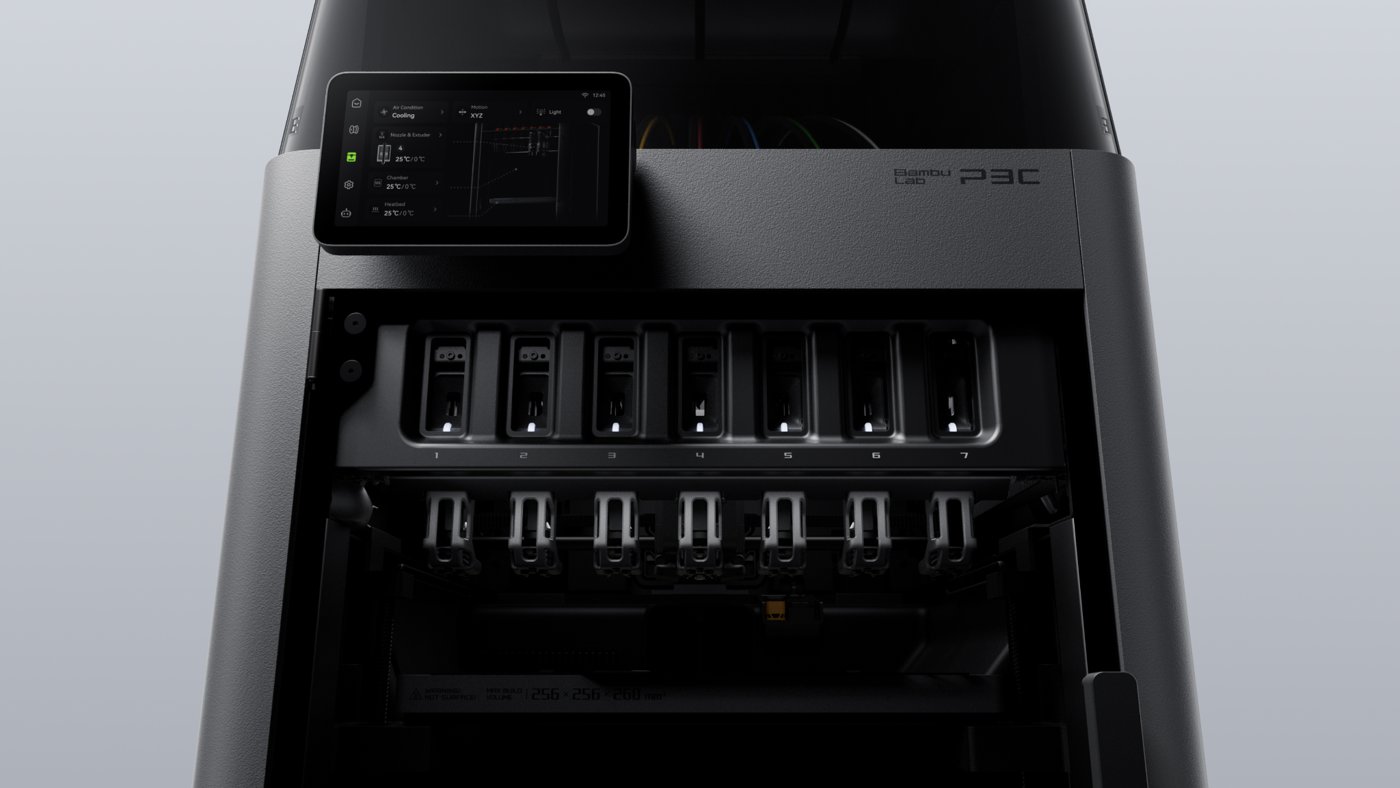
Each PrintTool carries its own filament path, heater, and power and data connection, so filament can stay loaded in the parked tool. Swaptek looks ahead, starts warming the incoming nozzle while the current one is still printing, and, in Bambu Lab’s internal tests with PLA Basic and a filament-saving purge mode, can get the new material onto the model in six seconds with a claimed purge of 0.038 grams. The company also quotes a 3.4-second tool switch. Real jobs with stickier materials or different slicer settings will be slower, and Bambu Lab is upfront about that in the footnotes. The rack also moves on the Z-axis as it hands off a tool, then tucks unused filament tubes away from the print.
The other headline feature is FlexFeed, a dual-diameter extruder that accepts both 1.75 mm and 2.85 mm filament. The thicker stock is meant for soft TPU, down to 75A, and Bambu Lab says that combination can reach up to three times the volumetric flow of a previous-generation machine running 1.75 mm filament, based on internal testing. The press release that went out today said “five times,” but the product page, the store, and the official footnotes all say 3×, so that’s the figure I’m using. One more catch: 2.85 mm is bypass feed only, and the dedicated TPU PrintTool is optional, not part of the $1,149 combo. You can also swap among 0.2 mm, 0.4 mm, 0.6 mm, and 0.8 mm hardened-steel nozzles mid-print, or mount optional CutTool, DrawTool, and DebossTool heads the same way you mount a PrintTool. Those CraftTools are sold separately, and mixed nozzle sizes need the extra hotends mentioned above.
To keep all of that aligned, the P3C runs an automatic Swaptek and nozzle-offset calibration before a multi-tool job. A built-in 1080p camera and a vision system watch for spaghetti failures, purge-bin jams, and clogs, and can compare the chamber to your slicer settings before the print starts. The upgraded Health Management System tries to explain problems in plain language, with MiniWiki walk-throughs on the touchscreen for common error codes. Just know that the optional BirdsEye top-view camera is sold separately, and Bambu Lab says the BirdsEye-enhanced monitoring is planned for the first half of 2027 and could still change.
What you can print, and what the specs actually say

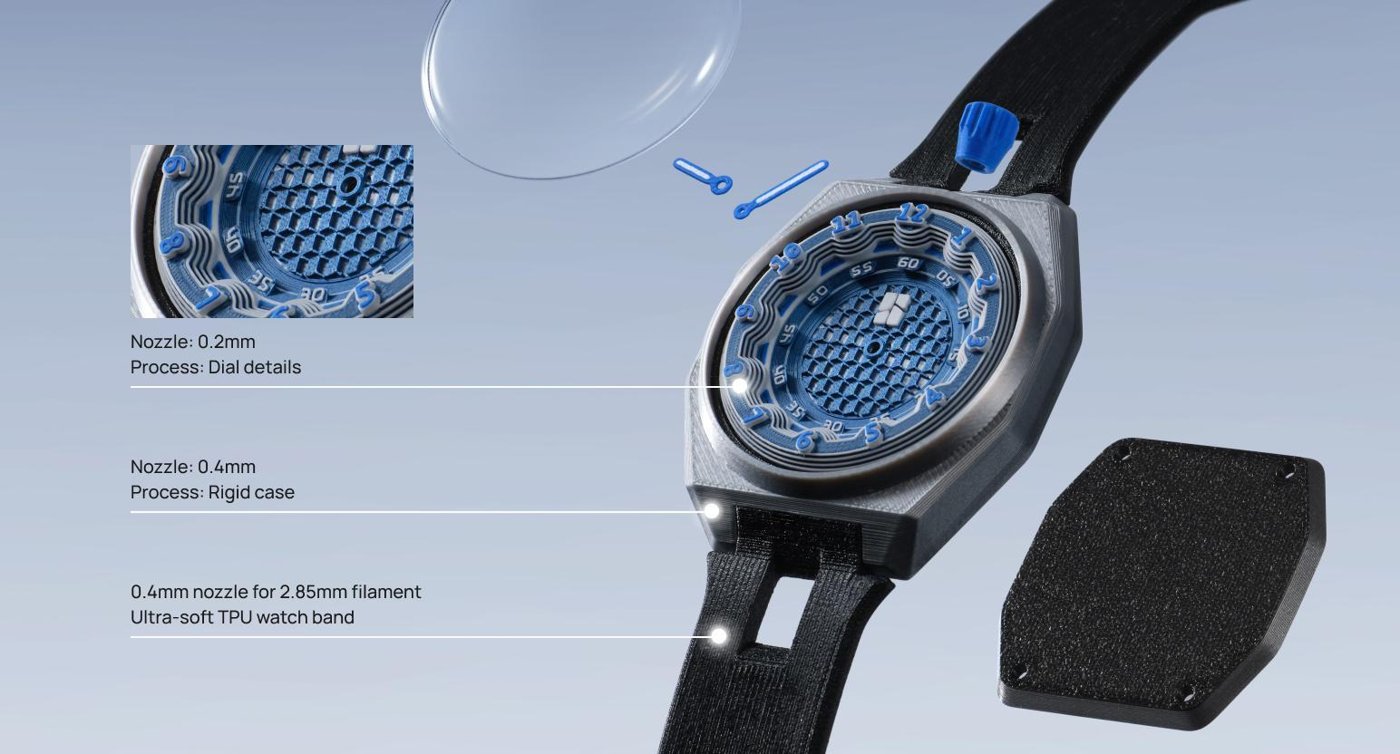
The reason a tool changer matters is that you stop flushing a single nozzle every time the color or material changes. Bambu Lab’s examples include a full-color hummingbird printed as one piece with CMYKW mixing, a shoe or bag that combines soft and firm TPU in the same part, and a watch that uses a 0.2 mm nozzle for the dial, a 0.4 mm carbon-fiber-reinforced nozzle for the body, and a 0.4 mm tool fed with 2.85 mm TPU for the strap. Color mixing is meant to be used with Bambu Lab’s PLA Palette filament, and the watch-style job needs extra 0.2 mm hotends and a 2.85 mm tool that aren’t in the base combo. If you don’t want to design any of that yourself, MakerWorld already has print-ready models and profiles aimed at the H3C and P3C.
The usable build volume is 256 × 256 × 260 mm. The machine measures 413 × 538 × 540 mm and weighs 26.5 kg with the AMS 3P installed. Maximum nozzle temperature is 300°C, the bed goes to 110°C, and the toolhead is rated for 1,400 mm/s and 25,000 mm/s² of acceleration. The AMS 3P holds seven spools on independent paths. If that’s not enough, an optional buffer on PrintTool No. 1 can attach up to four external AMS units, for as many as 22 colors. Built-in filtration uses a HEPA H11 filter plus activated carbon. The optional E1 purifier is a separate unit for VOCs, PM2.5, and microplastics. Supported materials include PLA, PETG, ABS, ASA, PA, PC, TPU, PVA, BVOH, and carbon- or glass-fiber reinforced blends. The full list is on the official specs page.
Cody’s take
I like the direction here more than I like the marketing language. A tool changer that starts at $1,149, instead of the H3C’s $2,499, is a real shift for anyone who has been watching this category from the sidelines. Keeping five materials loaded, sealed, and ready to swap in a few seconds can make multi-color and multi-flex prints feel routine.
I’m also not going to pretend the $1,149 machine is the one in the hero photos. If you want mixed nozzle sizes, 75A TPU, cutting and debossing, or a full seven-tool rack, you’re shopping for extras. The six-second swap and the 3× TPU flow numbers come from Bambu Lab’s internal tests, not from a week of prints on my bench. And the AMS 3P’s lack of automatic feeding is a small but honest limitation that should be on your list before you click buy.
If you’ve been waiting for Bambu Lab to put a proper tool changer under flagship money, the P3C is the one to look at, and you can order it today. Just budget for the tools you’ll actually use, and start with the product page and the U.S. store listing rather than the brochure. Bambu Lab also published a longer launch write-up this morning with the P3C versus H3C comparison.

